Engineer’s Note
When I first looked at this pump nameplate project, my first thought was: this is not just a plate with some text on it.
The pump model, rated parameters and serial number all had to be clear, of course. But I was also thinking about where the plate would actually go. On this type of equipment, it may be mounted on a pump casing support or a motor base. The surface may not be the same, and there may be limited clearance around the fixing area.
The environment was another thing we had to keep in mind. Pump rooms can be humid, with condensation, splashing liquid and regular cleaning. So before discussing the production route, I wanted to look at the whole picture: what information the plate had to carry, how the marking should be handled, and how the plate would fit the equipment.
That was the main point of this project for me. A nameplate may look like a small part, but it still has to work as part of the machine.
Project Overview
This project covered metal nameplates for a new industrial pump series. The plates were intended for centrifugal pumps and packaged water supply equipment, carrying pump model information, rated parameters and serial numbers.
| Item | Project Information |
|---|---|
| Industry | Industrial equipment and water pump manufacturing |
| Customer profile | Industrial water pump OEM |
| Equipment | Centrifugal pumps and packaged water supply equipment |
| Product | Metal equipment nameplates |
| Identification content | Pump model, rated parameters and serial number |
| Intended installation | Pump casing support or motor base, as specified |
| Relevant conditions | Humidity, condensation, pump-room cleaning and liquid splash |
| Engineering route | 304 stainless steel with chemical etching and paint fill |
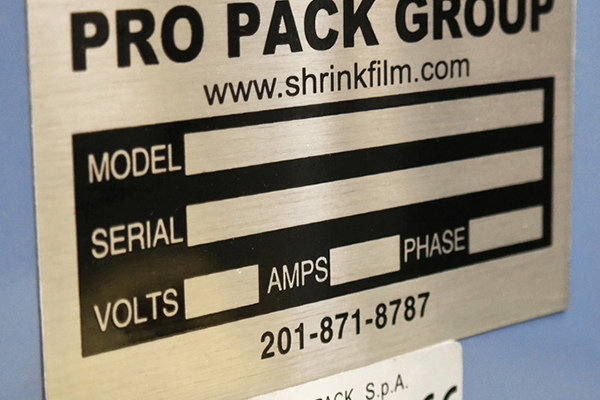
Illustrative product example; not a verified photograph from this project.
Why the Nameplate Needed Project Review
The new pump series brought different operating conditions into the nameplate discussion. The plate had to match the equipment information, the installation structure and the environment around the pump.
The main requirements were:
- Accurate equipment information: pump model, rated parameters and serial-number fields had to follow the applicable plate content and equipment information.
- Suitable marking: the marking route needed to be considered against humidity, condensation, liquid splash and routine cleaning.
- Mounting compatibility: the plate outline, curvature, clearance, holes and fixing arrangement needed to match the pump casing support or motor base.
- Version control: different pump models or parameter versions needed separate drawing, production and packing references where applicable.
For an industrial OEM, this means the nameplate cannot be treated as a generic metal label. It is a physical identification part that has to correspond with the equipment.
How Himgo Reviewed the Manufacturing Requirements
The review scope connected the customer’s equipment information, installation reference and marking requirements.
| Review Area | Manufacturing Focus |
|---|---|
| Customer information | Pump model, rated parameters, serial-number fields and applicable revision |
| Installation structure | Pump casing support or motor base, including flat or curved reference surfaces |
| Plate geometry | Outline, curvature, clearance, holes and fixing arrangement where applicable |
| Material and marking | 304 stainless steel, chemical etching and paint-fill requirements |
| Model control | Separation of drawing, production and packing references for applicable versions |
| Batch checks | Information accuracy, marking appearance, dimensions and mounting fit |
This is the type of review needed before the production basis is confirmed. The drawing, plate content, equipment structure and environmental conditions need to describe the same part.
Engineering Decision: Material and Marking Route
The project engineering route paired 304 stainless steel with chemical etching and paint fill.
Chemical etching was the marking direction for the pump information and serial fields. The review focused on character position, edge clarity and readability. Paint fill was considered for graphic contrast and appearance, with fill completeness, colour requirements, adhesion and contact with cleaning media requiring confirmation against the customer’s conditions.
This route was considered for the application; it was not treated as a universal corrosion or chemical-resistance guarantee. The relevant medium, contact frequency, cleaning method and acceptance conditions remained part of the project-specific assessment.
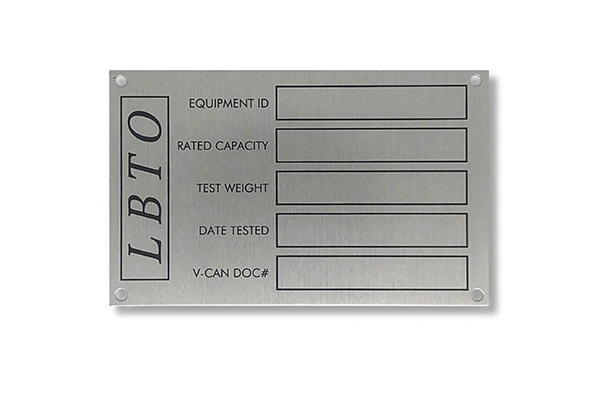
Illustrative product example; not a verified photograph from this project.
Mounting and Version Confirmation
Pump equipment may provide different mounting conditions. A casing support, motor base or other specified position may be flat or curved, with local clearance and fixing requirements affecting the plate form.
The confirmation scope included:
- The pump information and applicable artwork revision.
- Plate outline, curvature, clearance and hole layout where applicable.
- The relationship between the fixing arrangement and equipment structure.
- Marking appearance and readability under the stated environmental conditions.
- Separate drawing, production and packing references when different model versions applied.
These references give engineering, quality and procurement teams a shared basis for discussing the part. They also help keep one pump model’s parameters, plate version and packing identification separate from another specification.
Project Focus
What stood out in this project was the connection between pump data and physical installation conditions. The nameplate had to be considered as an equipment part: its material, etched and paint-filled marking, mounting geometry and model reference all belonged to the same manufacturing discussion.
For a similar project, Himgo can review the drawing, plate artwork, equipment information and installation requirements before discussing the manufacturing route.
Discuss a Similar Water Pump Nameplate Project
For a similar project, share the nameplate drawing, pump model and rated-parameter information, serial-number data where applicable, artwork, installation reference and expected quantity.
Also include relevant humidity, cleaning and liquid-contact conditions. Himgo can review the available project information and discuss a suitable manufacturing route for your equipment nameplates.
See custom equipment nameplates or discuss a similar project.